
Every business owner knows about the customer journey.
Awareness. Consideration. Decision. Loyalty. Advocacy.
We map it. We measure it. We obsess over every stage.
We know exactly where a customer drops off. What makes them stay. What makes them leave. What brings them back.
We have funnels for it. CRMs for it. Entire teams dedicated to it.
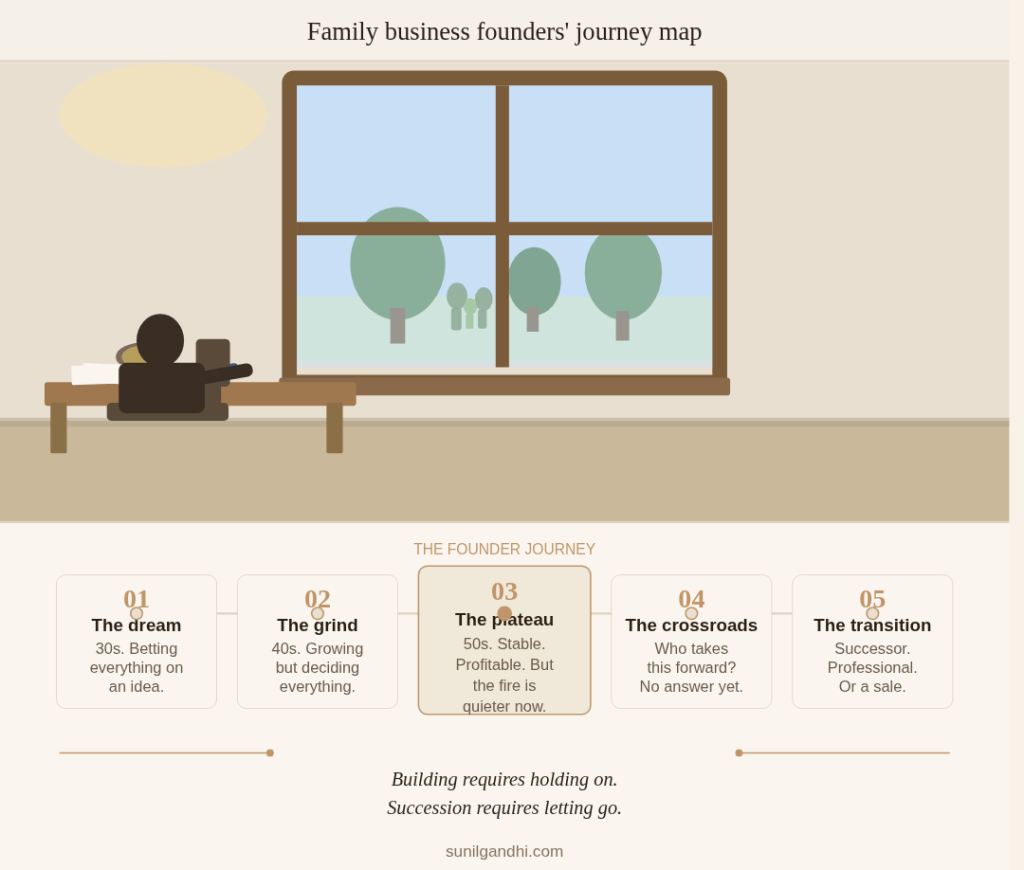
But here is what nobody talks about. The founder has a journey too. And almost nobody maps it.
It starts with a dream.
A founder in his 30s who sees an opportunity nobody else sees. Who bets everything — savings, relationships, sleep — on something that exists only in his head.
He is the business. The business is him. There is no separation.
Then comes the grind.
His 40s. The business is real now. Growing. Demanding. He is no longer doing everything — but he is still deciding everything. The team looks to him. The clients trust only him. The bank calls him directly.
He is irreplaceable. He tells himself this is success.
It is also the beginning of the trap.
Then comes the plateau.
His 50s. The business is stable. Profitable. Respected.
But something feels different.
The fire that got him here — quieter now. The Sunday mornings at the desk feel less like passion and more like obligation. His children are grown. His parents are ageing. His body is sending messages he keeps postponing to read.
He has built everything he set out to build.
And somehow — it is still not enough to let him rest.
Then comes the crossroads.
Who takes this forward?
A son who is capable but not ready. A daughter who is ready but not interested. A professional manager who is interested but not trusted. A buyer who is willing but not worthy.
Or nobody. And the founder keeps going. Not because he wants to. Because he does not know what stopping looks like.
This is the stage where most founder journeys stall.
Not because of the business. Because of the founder.
The customer journey has a clear goal at every stage.
Move the customer forward. Reduce friction. Build trust. Create loyalty.
The founder journey needs exactly the same thinking.
At every stage — what does the founder need to move forward?
In the early years — systems that reduce dependence on one person.
In the growth years — a leadership layer that can carry the business without carrying the founder.
In the mature years — a succession conversation that begins long before it is urgent.
At the crossroads — a companion who helps the founder see options they cannot see alone.
Nobody maps the founder journey because we assume founders figure it out themselves.
They built a business from nothing. Surely they can handle this. But the skills that build a business are not the same skills that transition one. Building requires holding on. Succession requires letting go. These are not the same muscle.
And most founders discover that only when it is almost too late to train it.
The crossroads does not announce itself. Most founders realise they are at Stage 4 only after they have already been there a while.
If something in this post felt familiar, that feeling is worth a conversation. sunilgandhi.com


Leave a Reply