Right now, as you read this, two of India’s most professionally run institutions are both scrambling with the same problem.
HDFC Bank’s CEO Sashidhar Jagdishan announced he won’t seek reappointment and will retire from the bank’s services on October 26, 2026. The bank has said the succession process is a work in progress, and analysts have flagged that the absence of clarity until now suggests the succession process has remained unresolved for some time.
Around the same time, Tata Group chairman N Chandrasekaran announced he would not seek reappointment when his current term expires in February 2027, following reports of boardroom tension and an unresolved succession plan — leaving one of India’s oldest conglomerates without a clear leader for the road ahead.
This is HDFC Bank. This is Tata Group. Professional boards, layers of governance, RBI oversight, decades of institutional memory. And even they are visibly, publicly struggling to hand over the baton cleanly.
Political parties face a version of the same problem — leadership transitions across the spectrum are rarely smooth, regardless of ideology, because the same forces are at work everywhere: power is hard to let go of, and there’s no dress rehearsal for succession.
So if scale, process, and professional management don’t automatically solve this — what actually does?
Here’s what separates organisations that survive a leadership crisis from ones that don’t. It usually isn’t the size of the company. It’s whether these four things were in place before the crisis hit:
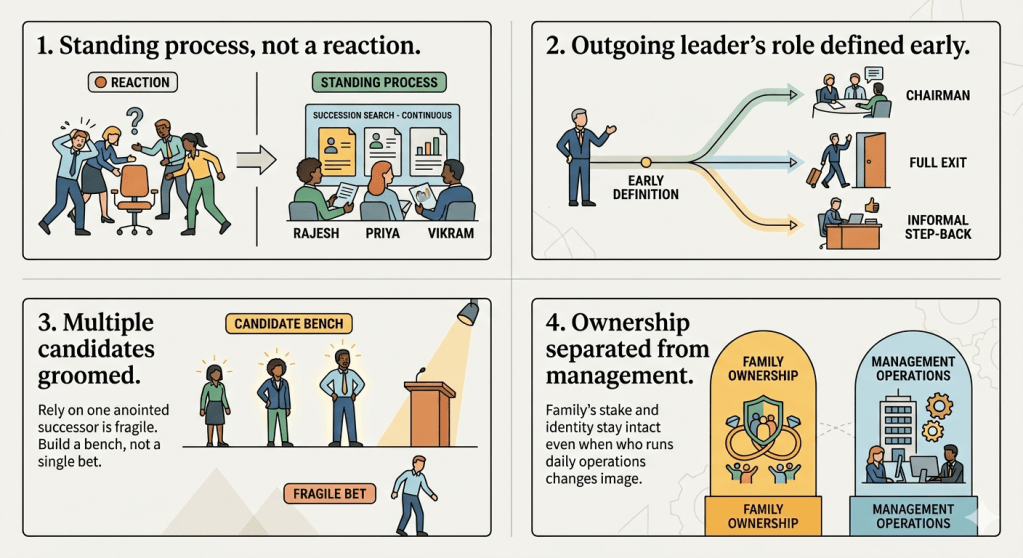
1. Succession is a standing process, not a reaction. HDFC Bank and Tata Group both have governance committees actively running search processes right now. That’s the model — a named committee, a defined process, always active, not assembled only when a CEO resigns.
2. The outgoing leader’s role is defined in advance. Ambiguity about what the departing leader does next — stays as chairman, exits fully, retains informal influence — is often what stalls a transition more than finding the right successor. Decide this before it’s needed, not during.
3. Multiple candidates are groomed, not just one. Both internal and external names are reportedly being weighed at HDFC Bank right now, precisely because relying on a single anointed successor is fragile — if that one person leaves, falters, or isn’t ready, there’s no fallback.
4. Ownership and management are separated on paper, not just in practice. The businesses that transition smoothest are the ones where the family’s role (ownership, values, long-term capital) is already distinct from who runs operations day to day — so a leadership change doesn’t threaten the family’s stake or identity.
Here’s the uncomfortable truth for family business founders: if HDFC Bank and Tata Group, with all their resources, are living through public succession uncertainty right now, “we’ll figure it out when the time comes” is not a plan. It’s a hope.
The businesses that handle this well don’t have less at stake. They just started the process years before they needed it.
#FamilyBusiness #SuccessionPlanning #SunilGandhi


Leave a Reply